“The hottest new domino game is 150 years old.”
Jim presents All About Sniff as the first comprehensive how-to guide for a game whose rules were largely passed down by word of mouth.
150years of tradition
40+years Jim has played
11practical chapters
Jim Smartt brings the delightful game of Sniff to domino players of all levels. “If Bridge is the best card game ever invented, Sniff deserves top ranking among domino games.” This AI-based interactive web experience will enable the novice to become proficient and the advanced players to improve their strategy.
Think you know Sniff?Are you good enough to beat Jim?Maybe it is time you gave it a shot. Play Jim →The boneyard contains all 28 dominoes in a double-six set. Select any face-down tile to reveal it.
Click or tap any domino to reveal it.Jim Smartt’s comprehensive guide preserves the rules, examples, scoring, strategy, and traditions that make Sniff distinctive.
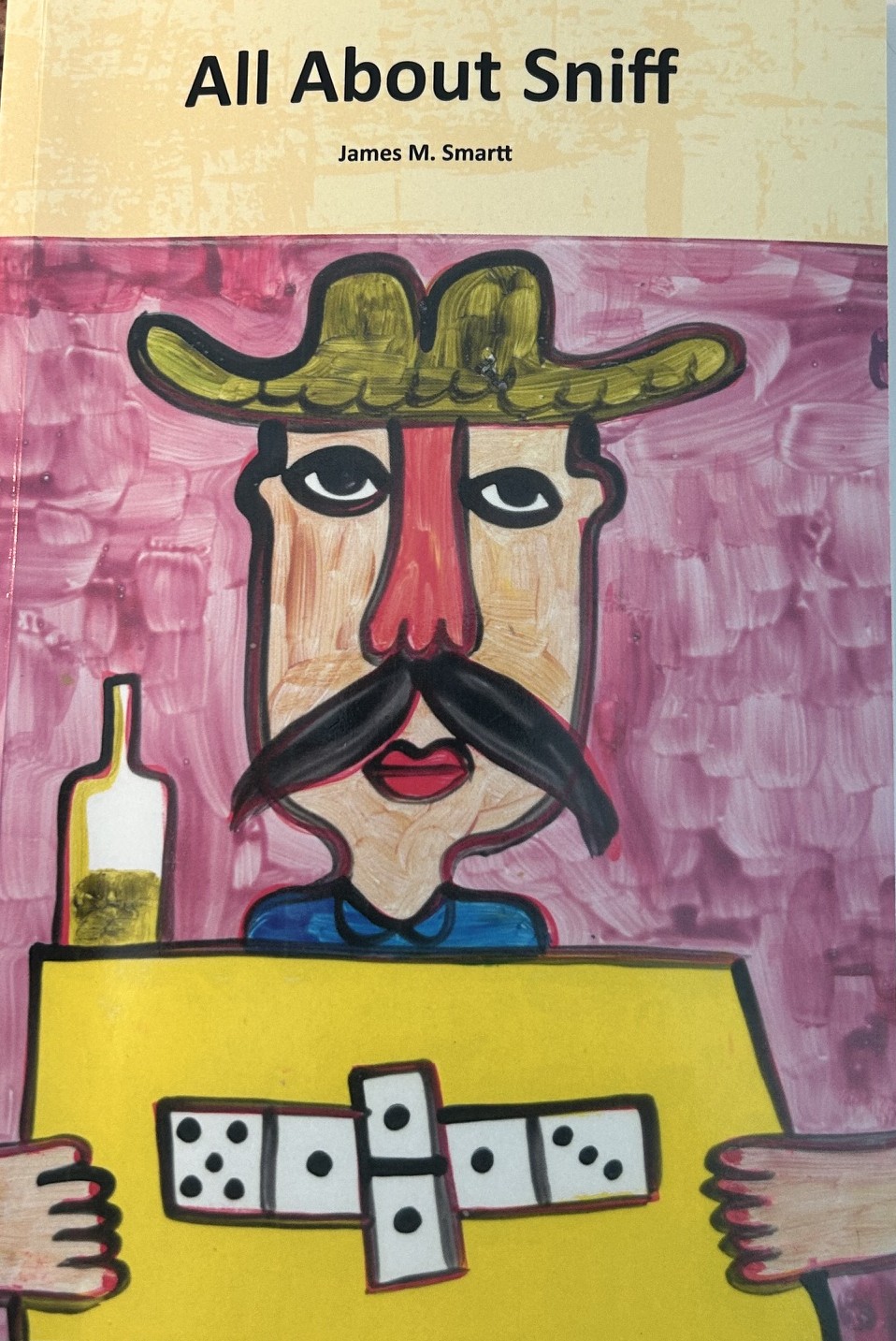
“The hottest new domino game is 150 years old.”
Jim presents All About Sniff as the first comprehensive how-to guide for a game whose rules were largely passed down by word of mouth.
James M. Smartt’s complete guide — the source every rule on this site is checked against.
01 · The rules
Verified against James M. Smartt's ruleset — the same rules this site's game actually plays by.
These are the confirmed rules of Sniff, as played and verified by James M. Smartt, author of All About Sniff. The rules below are common to every game. What changes for three and four players is set out at the end - and it is less than you might expect.
Sniff is a scoring and go-out game played with dominoes. The first player or team to reach 250 or more points wins the game.
A game is a series of hands. Each hand begins with a set — the first tile played — and ends when someone goes out by playing every tile in hand, or when the hand is blocked and nobody can play.
Points are earned two ways: by creating a board count that is a positive multiple of five during play, and by ending a hand with fewer tiles than your opponents.
Sniff uses all 28 tiles of a double-six set. Each end shows a number from 0 to 6; 0 is a blank. A single has two different values; a double has the same value on both ends. A tile is named by its values — a tile with 3 on one end and 4 on the other is the 3-4, or equally the 4-3.
A clutch is the group of seven tiles containing a particular value. There are exactly seven blanks, seven 1s, seven 2s, and so on through 6.
Players stand their tiles on edge, faces hidden from opponents. The number of tiles in each hand must stay visible to everyone.
Knowing every value appears on exactly seven tiles is central to deduction. As tiles appear, count each clutch to work out which values may still be in an opponent’s hand or the boneyard.
Turn all 28 tiles facedown and shuffle them thoroughly. Each player draws one tile. The higher total number of dots wins the right to set the first hand; if the totals tie, the tile containing the higher single value wins. If that ties too, draw again. Return the drawn tiles and reshuffle the complete deck before dealing.
The first setter may choose his chair.
Choose one player as scorekeeper and keep the score pad visible throughout. Place the boneyard at the corner opposite the pad, so the layout has room to grow between them. The scorekeeper must preserve the score each player began every hand with — that is what makes a renege adjustment possible later.
Turn all 28 tiles facedown and mix them. The setter draws first, and nobody else touches the deck until that draw is complete. The remaining tiles are moved into the boneyard without being exposed.
The setter may play any tile as the first of the hand — no match is required, because the layout is empty. Five sets score immediately:
| Set | Scores |
|---|---|
| 0-5, 1-4, 2-3 | 5 |
| 4-6, 5-5 | 10 |
The set is the only score that need not be called by the player. The scorekeeper must record it, and an omitted set score may be corrected at any time during that hand.
Choose a set that keeps the hand fluid. Favour values well represented in your hand, consider removing an inflexible double, and limit the opponent’s immediate scoring chances. A scoring set is useful, but not always better than one that improves your chance to play again and go out. Setting a single while keeping another tile of each of its values guarantees you can match whichever end the opponent uses next.
A player holding a playable tile must play one. You may not go to the boneyard instead. Couple one end of your tile to an open end showing the same value; the matched ends become dead for scoring, and the unmatched outer end becomes a new extremity.
Where a tile could go in several places, or several tiles could be played, the choice is yours. But a playable tile placed on the table with the intention of coupling it must be played and may not be taken back. The play is complete once the tile is properly coupled and you take your hand off it.
Before releasing a tile, compare every legal placement. A tile drawn from the boneyard may fit in several places, and one may score where another does not.
When an arm reaches the edge of the table, or interferes with the score pad or boneyard, reroute it with two 90-degree turns so it doubles back. The direction an arm runs has no effect on legal play or the board count.
The first double placed in a hand becomes the Sniff, also called the Spinner. It may be the set or appear later, and its identity never changes during that hand. It is the only tile that can eventually support play in four directions, and it is placed crosswise and centred on the line of play. Every later double is an ordinary double: usable in two directions only, and set offset with one half projecting beyond the line. That visual difference is how you identify the Sniff at a glance.
The Sniff must be developed in order: both long sides first, then its two short ends. No play may be made on a short end until both long sides are covered.
| State of the Sniff | Where another tile may be played | Contribution to the board count |
|---|---|---|
| Set as the only tile | Either long side | 2 × its number |
| One long side covered | The opposite long side | 2 × its number |
| Both long sides covered | Either short end | 2 × its number |
| One short end also covered | The remaining short end | Its number |
| All four directions covered | Nowhere on the Sniff | 0 — the Sniff is dead |
There can never be more than four playable or scoring extremities on the layout. Only the first double is the Sniff — every later double stays an ordinary double even after the Sniff is fully covered and dead.
An ordinary double at an extremity contributes both halves, so an exposed double-n counts 2n. Once another tile is coupled to it, the double is cut off and contributes nothing; the new outer end replaces it in the count.
Doubles are inflexible — they match only one value. Remove them when it is safe and useful, but weigh the score or the opening you may hand the opponent.
After every play, total all scoring extremities. If the layout is a single set tile, both its ends count. Once a single has been coupled in, count only its exposed outer value. An ordinary exposed double counts both halves; the Sniff counts by the stage table above.
If the board count is a positive multiple of five, the player scores that full amount. If it is not a multiple of five, there is no score. The highest possible play score is 35.
Track the board count after every turn. Rather than recounting from zero, add or subtract the change the new tile caused, and consider which legal changes would reach the next multiple of five.
Except for a scoring set, a score must be announced before the next player couples a tile. Miss that moment and the score is lost. Any player may correct an undercall, an overcall or a nonexistent score before the next tile is coupled — after that the announced score stands, even if it was mathematically wrong.
An automatic is a tile that preserves or changes a just-scored multiple of five by another multiple of five, producing an immediate counter-score. Automatics are strategy rather than a separate rule — the resulting board count must still be called normally.
The most versatile are the 0-5 and the 1-6, which is called the Pet. The Pet is not an automatic when played directly on an exposed double-1 or double-6.
| Exposed ordinary double in the prior score | Counter-scoring partner |
|---|---|
| Double-blank | 0-5 |
| Double-1 | 1-2 |
| Double-2 | 2-4 |
| Double-3 | 3-6, or 3-1 — the Fake Pet |
| Double-4 | 4-3 |
| Double-5 | 5-0 |
| Double-6 | 6-2 |
A separate Sniff automatic applies while the Sniff has only one long side covered and is part of a score: a single matching the Sniff’s number, with a blank or 5 on its other end, played on the opposite long side, preserves the score or increases it by five.
Memorise the automatics. Note also which automatic an opponent fails to use — the absence may tell you what he does not hold.
A bulletproof or safe layout is one no remaining legal tile can score on. A leadback is a play that returns a value the opponent wants, helping him score, stay fluid or go out.
Score when you can, but control the extremities. Keep more than one playable value in hand. Defending, reduce the board count, cover the values the opponent favours, avoid leadbacks, and prefer a bulletproof layout when one is available.
Draw one facedown tile, provided the protected reserve will remain. The instant a drawn tile is examined it is committed — if it plays, it must be played that turn. If it does not, add it to your hand and draw a second, again only if the reserve will remain. If that one plays it must be played; if not, add it and pass.
You may never draw more than two tiles on one visit to the boneyard. A draw is complete when you see the face or feel the dots.
In two-player Singles the last two boneyard tiles are never examined or played, so no draw may take the boneyard below two. If you cannot play when only the protected tiles remain, you pass; your opponent continues if able. The hand ends only when nobody can play — any legal play in between resets the sequence of passes.
A player goes out by legally playing his last tile, and the hand ends immediately. He receives the total dots left in the opponent’s hand, rounded to the nearest five, on top of any play scores already earned. The award may be 0 if the opponent has nothing left.
A hand is blocked when nobody can legally play and no legal draw remains. Each player totals the dots in his own hand, and the lower total receives the opponent’s full remaining total, rounded to the nearest five — not the difference between the hands. Equal totals score nothing for either player.
Rounding: remainders of 0, 1 or 2 round down; 3 or 4 round up.
The first player to reach 250 or more wins. Exactly 250 is not required.
The set alternates from hand to hand and keeps alternating between games for as long as the players keep their seats. Winning the previous game does not earn the next set. Each new hand starts from a full reshuffle of all 28 tiles and re-deal (4.1).
A renege — or revoke — is the only formally penalised offence in Sniff. It happens when a player holds a playable tile but goes to the boneyard instead, or draws a playable tile and passes rather than playing it.
Discovered, announced and proved before the next hand begins, the hand stops immediately. The offender loses every point earned in that hand and a further 25 points; the score may go negative. The other player keeps points already recorded but receives no further score and no go-out award. A player is not required to report an offence he did not notice — if nobody proves it in time, play proceeds as though it did not happen.
By prior agreement an alternative may be used: play the hand out, keep all points scored, and deduct 50 from the offender at the end. The 25-point procedure above is preferred.
By the book, game-related speech is limited to:
No player may reveal useful information about his own holdings or strategy, suggest a play, mislead an opponent with game information, or signal through speech or handling of tiles. Social talk is fine only while it conveys nothing useful about the hand.
Keep faces concealed but tile counts visible. Do not bow or manipulate your hand in a way that hints at what is playable. Wait for the preceding player to finish drawing. Keep the score pad in view, protect the boneyard, and play with reasonable dispatch — the dots will not change while you deliberate.
These principles summarise the book’s strategic guidance. They never override a mandatory rule.
After a game is won, the book offers an optional game-point award based on the losing player’s final score. These may be used to score a series across a day’s play; any monetary use is a separate agreement and is not required to play Sniff.
| Loser’s final score | Game points to the winner |
|---|---|
| 0–25 | 14 |
| 30–75 | 12 |
| 80–125 | 10 |
| 130–150 | 8 |
| 155–175 | 4 |
| 180–225 | 3 |
| 230–250 | 2 |
A loser at 150 or below is Rubed; reaching 155 crosses the Rube line.
| Tile | Name used in Sniff |
|---|---|
| 0-0 | Little Nothing |
| 1-1 | Snake Eyes, Bird Balls, or Ani |
| 2-2 | Ducks, or The Bishop |
| 2-3 | Little Gem |
| 3-3 | Irish Curse, or Curse of the House of Thompson |
| 4-4 | House with Two Rooms |
| 1-6 | Pet |
| 1-3 | Fake Pet |
| 5-6 | Catherwood |
| 4-5 | Reverse Catherwood |
| 6-6 | Boxcars |
Everything above is common to every game of Sniff. Only three things change with the number of players — the draw, the protected reserve, and, in the four-player game, that you play in partnerships.
| Players | Tiles each | Boneyard | Never drawn | Format |
|---|---|---|---|---|
| Two — Singles | 7 | 14 | 2 | Each for himself |
| Three — the Three Game | 6 | 10 | 1 | Each for himself |
| Four — Doubles | 5 | 8 | none | Partners, sitting opposite |
Also called Cutthroat or Screw Your Buddy. Each player is on his own. Each draws six tiles, and one tile must remain in the boneyard, never drawn.
The set rotates clockwise from hand to hand, and keeps rotating between games while the players keep their seats — it does not alternate as it does with two.
The player who goes out is awarded the combined total of the dots left in both opponents’ hands, rounded to the nearest five. If the hand is blocked, the player holding the fewest pips takes both opponents’ totals combined — again the full total, not the difference — and a tie for lowest scores nothing.
With three players, when one pulls ahead the other two can defend jointly: the player to his right makes it as easy as possible for the third player to score, while the third makes it as hard as possible for the leader to score or go out.
Partners sit opposite one another, so play alternates between the two sides as it passes round the table. Each player draws five tiles, and no tile is protected — unlike two- and three-player Sniff, the boneyard in Doubles may be drawn dry. Play proceeds clockwise, and the set rotates clockwise from hand to hand and between games.
The partnership of the player who goes out receives the combined dots left in both opponents’ hands, rounded to the nearest five. Scores are kept by partnership, and the first partnership to 250 wins. If the hand is blocked, each partnership’s two hands are added together and the lower total takes the opposing partnership’s combined total; tied totals score nothing.
Penalties fall on the partnership: a renege costs the side any points recorded that hand and a further 25, and a partnership score may go negative. The etiquette rules apply without relaxation between partners — you read one another from the tiles played, never from anything said at the table.
Watch for anything that might be a signal, from partner and opponents alike. Try not to cut a number your partner has put up. Give him choices by populating the extremities with different numbers so he stays fluid. Make it as hard as possible for your opponents to score and go out. Be keenly aware of who is in the go-out seat — and abandon any of this for a sizable score. A partner who sets a double is usually indicating a preference for that number rather than setting bareass.
Source: Rules for Two-, Three- and Four-Player Sniff, Final 1.1, prepared from the 2024 edition of All About Sniffand confirmed by James M. Smartt. Section numbers on this page are the ruleset’s own.
02 · Learn to play
The best way to learn Sniff is to read the rules and then play the game. This guided table explains every action, why it was legal, and how it affected the score.
Meet the Sniff, understand the open ends, and learn when the board scores.
Read the rulesChoose your difficulty level and then learn from the explanation after every move.
Go to the tableJim will show you all of the right moves - and explain each decision along the way.
03 · Playing against Jim Smartt
A real Sniff opponent, built from Jim Smartt’s confirmed ruleset — scoring, the boneyard’s protected reserve, and the true four-direction Sniff spinner all play by the book. Play it two-handed, three-handed, or as partnership Doubles.